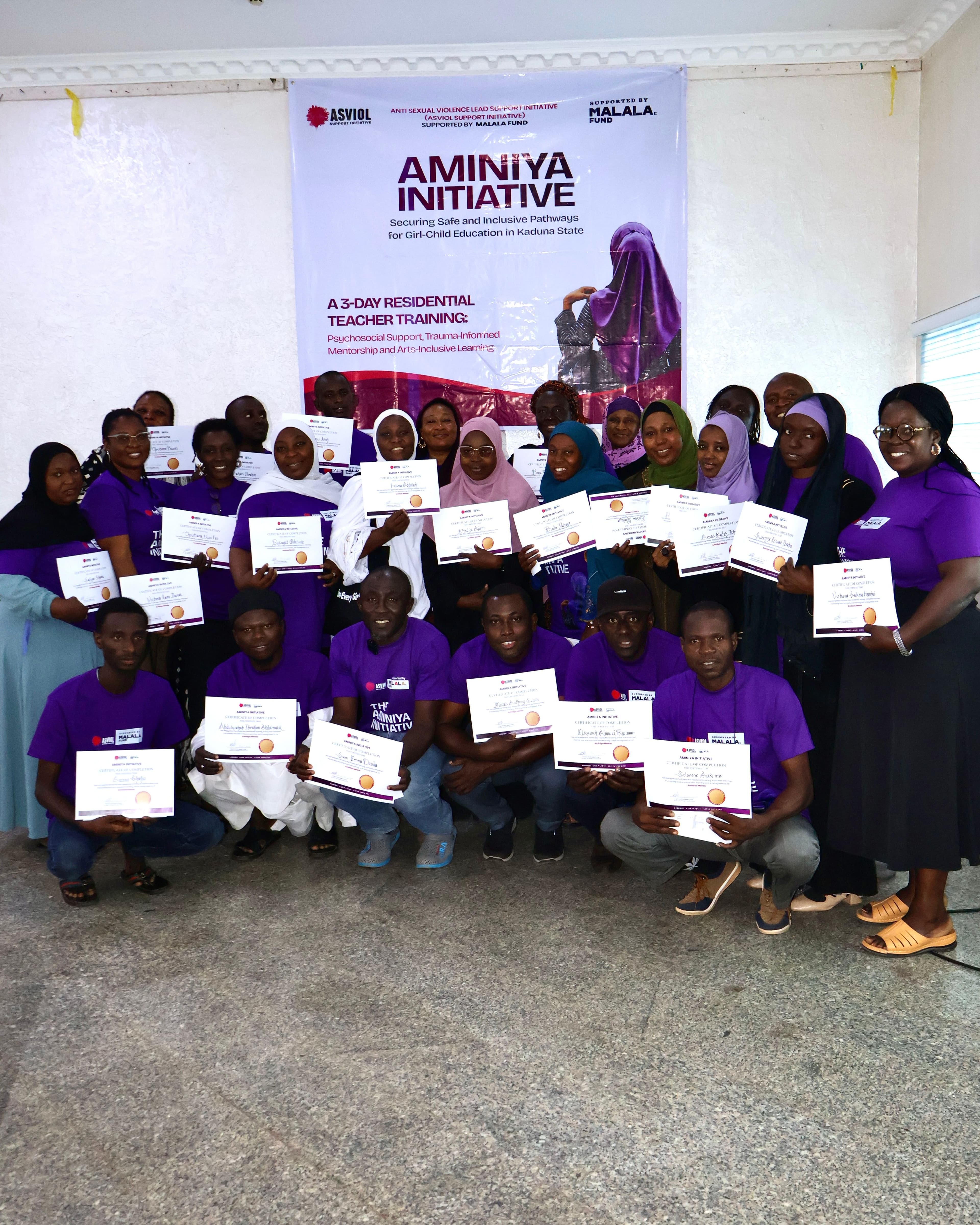
The Anti Sexual Violence Lead (ASVIOL) Support Initiative has trained 25 teachers from six schools in Kaduna State as Aminiya Mentors, to support adolescent girls at risk of dropping out of school and those seeking to resume their education after an interruption.
The three-day residential training, held from October 15 to 17, 2026, at ASAA Pyramid Hotel, Kaduna, was organised under the Aminiya Initiative: Securing Safe and Inclusive Pathways for Girl-Child Education in Kaduna State. The initiative is implemented by ASVIOL Support Initiative with support from the Malala Fund and led by the organisation’s Executive Director and member of the Malala Fund Education Champion Network, Cohort 8, Hassana Maina.
The training addressed a persistent challenge in Kaduna State: many adolescent girls are unable to complete secondary school, not because they lack the ability to learn, but because of circumstances that force them out. Early marriage, teenage pregnancy and sexual and gender-based violence are major barriers to girls’ education. While marriage and pregnancy can lead to girls dropping out, harassment and the stigma that follows can make returning to school difficult, even when policies protect their right to continue their education.
Participants (Teachers) were drawn from government girls’ secondary schools in Barnawa, Kakuri, Maimuna Gwarzo, Makera, Kurmin Mashi and Queen Amina College. The participants included subject teachers and guidance counsellors.
A representative of the Kaduna State Ministry of Education, Mrs Aishatu Muhammad, who is also the Deputy Director of Public Schools and Gender Officer, commended the initiative for strengthening support for girls whose education had been disrupted.
She noted that equipping teachers with the necessary knowledge and skills would enable them to play a more active role in helping girls return to school and complete their education.
During the training, participants examined the major factors preventing girls from accessing or completing their education, including early marriage, teenage pregnancy, sexual and gender-based violence, financial hardship, family pressure, stigma and inadequate emotional support.
They also explored how a girl’s absence from school is often the result of harm done to her rather than a choice she made, while reviewing relevant state policies and legal frameworks for girls’ education, including the Child Welfare and Protection Law 2018, the Kaduna State Policy on Gender in Education and second-chance education opportunities.
The training further examined the emotional challenges girls may experience when returning to school, with participants identifying shame, fear, mockery and loneliness as some of the difficulties they could face.
Teachers were encouraged to become trusted adults, confidants and sources of support who can help girls feel safe, accepted and encouraged to continue their education.
To strengthen their mentoring skills, participants were introduced to the principles of psychological first aid and the Look, Listen, Link approach to supporting learners experiencing distress.
They also practised listening without judgement and respecting a girl’s decision not to disclose more information than she feels comfortable sharing.
The sessions highlighted the importance of safeguarding and appropriate referrals, particularly when a girl discloses abuse or other forms of violence.
Participants were cautioned against investigating suspected abuse themselves and were guided on the importance of following established reporting and referral procedures.
The Do No Harm principle was emphasised throughout the training, with facilitators reminding teachers that their words and decisions could either protect vulnerable learners or expose them to further harm.
The programme also addressed the emotional demands of mentoring through sessions on self-care, wellness activities, drawing and storytelling, highlighting the need for teachers to maintain their wellbeing while supporting vulnerable learners.
Speaking during the training, Hassana Maina urged teachers to look beyond school enrolment figures and pay attention to how girls are treated when they return to the classroom.
“Let girls be girls; let them experience childhood. Do not make their childhood adulthood,” she said.
Schools to Implement Mentoring Plans
As part of efforts to translate the training into practical action, each school team developed an action plan to share the knowledge acquired with colleagues and learners through step-down training sessions and school-based sensitisation activities.
ASVIOL Support Initiative also pledged to support the six schools in finalising their plans, establishing safeguarding and referral procedures, and conducting regular follow-up meetings with the Aminiya Mentors.
The follow-up activities are expected to monitor the application of the knowledge gained during the training and identify areas where additional support may be required.
The initiative is expected to strengthen efforts to ensure that policies supporting girls’ education are backed by practical support systems within schools, particularly for adolescent mothers and married girls seeking to return to education.
About ASVIOL Support Initiative and the Aminiya Initiative Project
The Anti Sexual Violence Lead (ASVIOL) Support Initiative is a women-led civil society organisation dedicated to preventing and responding to Sexual and Gender-Based Violence through advocacy, curriculum development, policy engagement, community mobilisation and systems strengthening.
The Aminiya Initiative, which means “trusted confidant” in Hausa, is a school-based intervention that trains teachers to serve as mentors and provides structured support to help adolescent mothers and married girls return to school and remain in education.
ASVIOL Trains 25 Kaduna Teachers to Support Girls’ Return to School, Retention
A
BY Aisha Muhammed kuduPublished October 28, 2026